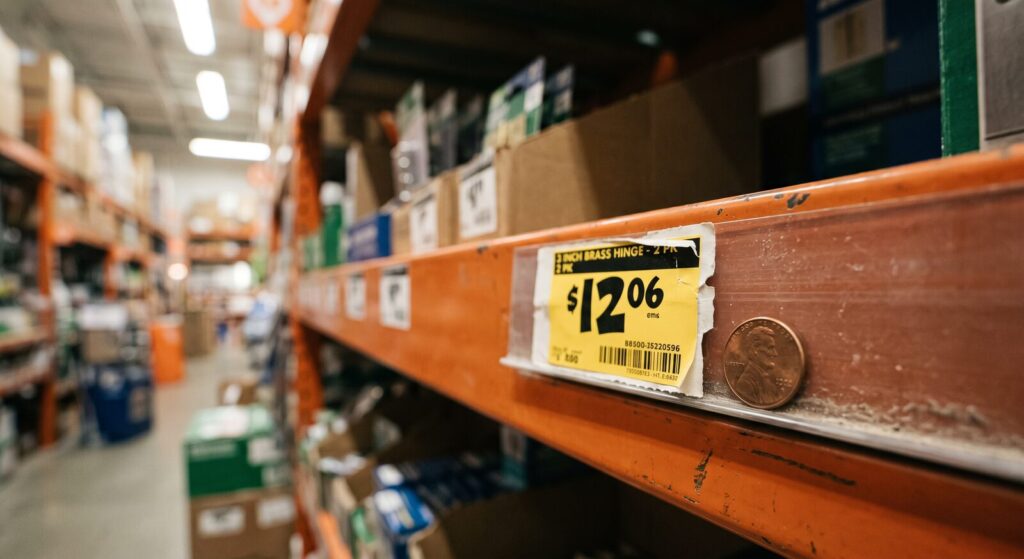
Somewhere in your local Home Depot, right now, there is probably an item that rings up for one cent. Not a rounding error. Not a glitch. A deliberate, systemic penny – the final stop on a countdown clock that Home Depot denominates entirely in cents.
After ten years of hunting Costco’s .97 markdowns, we can say this with love: Home Depot runs the most predictable clearance system in American retail, and it publishes the schedule right on the price tag. You just have to know you’re looking at a clock.
Here’s the pattern regulars have sworn by for years. When clearance starts, the price drops to something ending in .06 – that’s the first markdown, and the item has roughly six weeks to sell. Still on the shelf after that? It drops again, now ending in .03, and the clock shortens to about three weeks. After the .03 window closes, the item goes to a penny in the system, which is Home Depot’s way of declaring it dead.
Home Depot has never officially confirmed one syllable of this. The pattern has held for a decade anyway. Corporate silence is its own kind of confirmation.
Now the a-ha. Look at the small date printed on the tag itself. That’s when this price took effect. Pair it with the cents ending and you can do actual math: a .06 tag dated five weeks ago has about a week left before it drops to .03. A .03 tag dated three weeks ago is a penny candidate any day now.
Most people see a price. You’ll be reading a countdown, with a timestamp, in public, that the store swears isn’t there. It’s the closest thing retail has to insider trading that’s completely legal.
A penny price is not a deal in the normal sense. It’s an internal write-off flag that means “pull this from the shelf and dispose of it.” Employees are supposed to sweep penny items off the floor before customers ever see them. Finding one means the sweep missed. The register will happily ring $0.01, but store policy on actually selling it varies – some managers honor it with a laugh, some refuse on the spot, and both are technically right.
The etiquette, learned the polite way: do not argue with the cashier, do not demand, and do not film anyone. Penny hunting is a privilege of the inattentive stockroom, not a consumer right. Be gracious and you’ll be back next week. Be a headache and the whole store starts sweeping better, which ruins it for everybody.
Clearance at Home Depot clusters hard around seasonal handoffs. Garden gets purged in late summer and fall. Holiday decor dies in January, spectacularly. Grills and patio drop as back-to-school shows up. If you only make a few reconnaissance trips a year, make them in the two or three weeks after a season ends, when whole aisles hit .06 at once.
And check the back. The official clearance racks live near the rear of the store, plus the endcaps nobody walks past on purpose. Ten years of clearance hunting across every chain we cover, and the single most reliable rule is still: the good stuff is wherever the foot traffic isn’t.
Walk the back racks. Read the cents. Read the date. Do the math. If it ends in .06 with time left, decide if the current price is already good. If it ends in .03 on an old date, you’re gambling that it survives until the next drop – a real gamble, because everyone else reading tags is running the same math. And if it rings a penny, smile, be kind, and accept whatever verdict the manager hands down.
Home Depot is one chapter of a bigger book. The whole phrasebook, every chain’s tells in one place, is right here.
We post the Home Depot markdowns our community confirms, dates and all. Spot a .03 aisle mid-collapse before we do? Share the find. Somebody two towns over has a truck and no self-control, and you’re about to make their week.