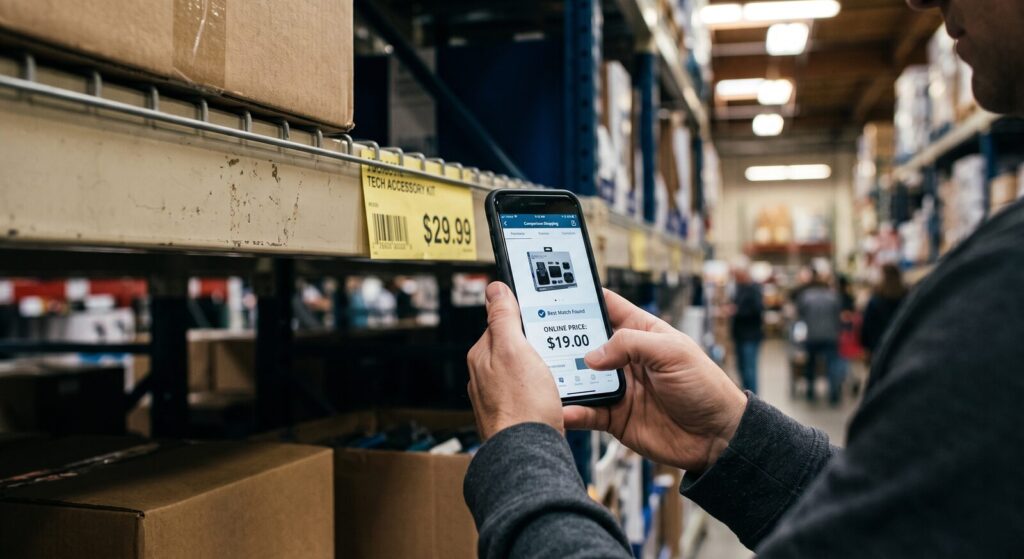
The shelf tag at Walmart is an unreliable narrator. It will look you dead in the eye and say $24.98 while the actual price is $6.50. It has been $6.50 for three weeks. The tag simply never got the memo, and honestly, it may never get the memo.
We spent ten years decoding Costco price tags, so we thought we’d seen every way a store could hide a deal. Then we scanned a clearance-aisle George Foreman grill at a Walmart outside Sacramento and watched the app say $9. The shelf said $34.88. Nobody working there knew. That’s not a markdown. That’s a secret.
Welcome to hidden clearance. Here’s the whole game.
This is the part that makes everything click: Walmart’s price changes happen in the computer first. Corporate pushes a markdown to the system, and the new price is live at the register that moment. The paper tag on the shelf gets updated whenever a human with a label gun gets around to it. In a store with 100,000 items and a to-do list the length of a CVS receipt, that lag runs days. Sometimes weeks.
That lag is the entire opportunity. The deal is real, it’s just unadvertised – our favorite kind. Nobody is racing you to it because nobody knows it’s there.
Open the Walmart app, make sure it’s set to the store you are standing in, and scan the barcode. Whatever the app says is what the register will say. That’s it. That’s the whole technique. Ten seconds, and the shelf tag’s opinion stops mattering.
One warning from experience: set the store first. The app quietly defaults to whichever location you visited last, and there is a special kind of heartbreak in scanning a $4 air fryer that turns out to be $4 at a store two towns over.
Walmart loves the word rollback, and most shoppers treat it as a synonym for clearance. It isn’t. A rollback is a temporary promotion – the price drops for a few weeks, then climbs right back up like nothing happened. Clearance is terminal. That price only moves in one direction, and the item is not coming back.
So a rollback says “buy it if you were going to buy it anyway.” Clearance says “the store has given up, negotiate accordingly.” Knowing which one you’re looking at changes whether you should wait for another drop. Rollbacks don’t drop again. Clearance usually does.
Here’s the one that separates the tourists from the regulars. When you’re looking at an item in the app, check its availability at other stores. If a nearby store shows the item at $0.00, that item has gone penny – marked down to a cent, flagged for removal from inventory. It technically shouldn’t be on the shelf at all. Sometimes it still is.
A $0.00 listing is the app accidentally telling you where the bodies are buried. We’ve followed that breadcrumb to more than one absurd receipt. No promises, and plenty of hunts end with an empty shelf and a shrug. But when it hits, it hits.
Actual clearance at Walmart lives in three places, in ascending order of chaos. The marked clearance aisle, usually back by seasonal. The endcaps facing the back wall, where things go to be forgotten. And the great diaspora: clearance items reshelved in completely wrong sections by shoppers who changed their minds somewhere around aisle 12. The app’s aisle locator helps you find where an item is supposed to be. What’s actually there is between you and the retail gods.
Every hidden-clearance story ends the same way: standing at self-checkout, scanning the thing, and watching the little screen render its verdict. The screen doesn’t lie. The screen has never lied. When it flashes a number 80% below the shelf tag, you are allowed exactly one quiet fist pump. We don’t make the rules, but we do enforce that one.
Walmart is just one dialect. The full store-by-store cheat sheet, every chain’s tells in one place, lives in our price tag phrasebook.
We post the best Walmart finds here as we and our community confirm them – and if your app scan turns up something ridiculous, share the find so the rest of us can go ruin our grocery budgets too.